What Is a SOA Record Explanation
- 1.
Y’all Ever Wonder Why the Internet Don’t Just Collapse Like a House of Cards in a Texas Dust Storm?
- 2.
So… What Does SOA Mean in Networking? (Hint: It Ain’t “Stack of Avocados”)
- 3.
Peekin’ Under the Hood: The 7 Clauses That Make a SOA Record Tick
- 4.
What Is the SOA Start of a Domain? (No, It’s Not the “www” Part)
- 5.
Real Talk: What Happens If There Is No SOA Record? (Spoiler: It’s Ugly)
- 6.
Does a CNAME Need an A Record? (And How SOA Fits Into the Drama)
- 7.
SOA Serial Numbers: The “Oops I Broke Prod” Prevention Tool
- 8.
SOA and DNS Propagation: Why Your “Quick Fix” Ain’t Instant
- 9.
Troubleshootin’ SOA Like a DNS Whisperer (Tools & Telltale Signs)
- 10.
Where to Go Deeper (‘Cause DNS Is a Rabbit Hole, and We Love It)
Table of Contents
what is a soa record
Y’all Ever Wonder Why the Internet Don’t Just Collapse Like a House of Cards in a Texas Dust Storm?
Hell nah—it’s held up by invisible duct tape, prayer, and—yep—SOA records. Seriously, if DNS is the phonebook of the internet (and it *is*), then the what is a soa record question? That’s askin’ who wrote the first page, stamped the edition, and set the rules for how often folks gotta check for updates. Spoiler: it ain’t magic. It’s *Start of Authority*. And no, it’s not some secret Illuminati handshake—it’s just the quiet overlord runnin’ the whole DNS show behind the curtain. Think of it like the foreman on a construction site: nobody sees ‘im much, but if he steps out for coffee? *Everything* slows down—or worse, falls apart.
So… What Does SOA Mean in Networking? (Hint: It Ain’t “Stack of Avocados”)
SOA stands for Start of Authority—and no, we didn’t make that up after two cold brews and a questionable taco. In DNS terms, the what is a soa record answer starts right here: it’s the *first* and *most authoritative* record in any DNS zone file. Every domain—yourdomain.com, bigtech.corp, even grandmasapplepies.net—gotta have one. Without it? Your DNS server’s basically wanderin’ around with no map, mutterin’ “uhhh… where do I go now?”
Fun fact: the SOA record isn’t just a label—it’s a *contract* between DNS servers. It says: ✅ *“This is the main source of truth.”* ✅ *“Here’s who’s in charge (the primary nameserver).”* ✅ *“Here’s how often you should check back for updates.”* ✅ *“And hey—if things go sideways, here’s how long you can keep servin’ old data before givin’ up.”*
In other words: what is a soa record? It’s the heartbeat monitor for your domain’s DNS health. Flatline? Uh-oh.
Peekin’ Under the Hood: The 7 Clauses That Make a SOA Record Tick
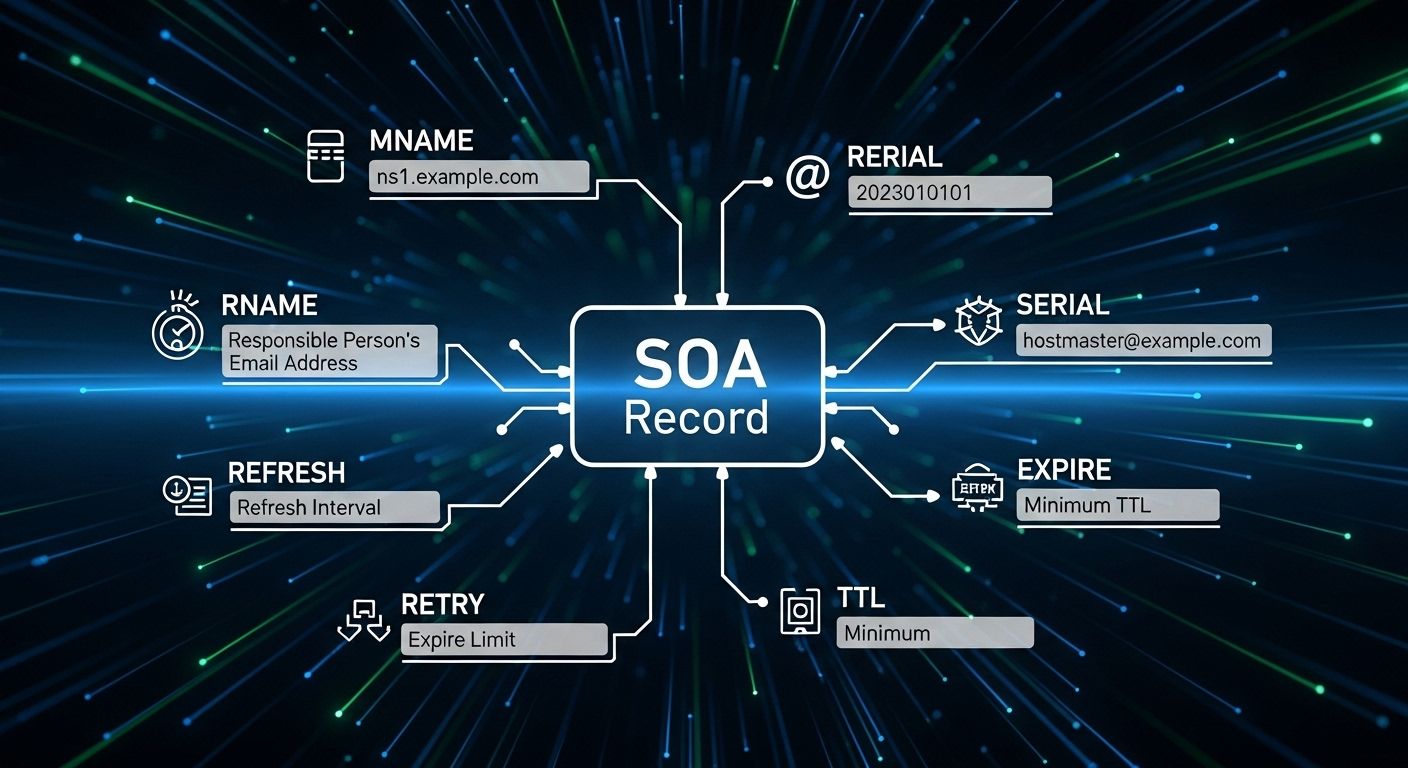
Alright, gearheads—time to crack open the hood. Every what is a soa record deep dive needs this breakdown. Here’s the full gang, in order (and yeah, the syntax matters—like puttin’ sugar *before* the butter when makin’ biscuits):
| Field | Example | What It *Actually* Means (No Jargon) |
|---|---|---|
| MNAME | ns1.yourhost.com. | The *primary* nameserver—like the head chef. All changes start here. |
| RNAME | admin.yourdomain.com. | Admin’s email—but swap the @ for a dot. So admin@yourdomain.com → admin.yourdomain.com. (Weird? Yep. Standard? Also yep.) |
| SERIAL | 2025111801 | Version number. Format: YYYYMMDD##. Change this *every* time you tweak DNS—or secondaries won’t update. (Forgot it? Congrats, your new A record’s livin’ in the past.) |
| REFRESH | 10800 (3 hrs) | How often secondary nameservers call home to ask, *“Hey, anything new?”* |
| RETRY | 3600 (1 hr) | If the first call fails? Wait this long, then try again. Like knockin’ on a screen door twice. |
| EXPIRE | 604800 (7 days) | Max time a secondary can serve stale data if it *still* can’t reach the primary. After this? “I got nothin’.” SERVFAIL city. |
| MINIMUM (TTL) | 300 (5 mins) | Default cache time for *negative* responses (like “NXDOMAIN”)—not for regular records (that’s per-record TTL). |
Notice how every field ties back to reliability, sync, and accountability? That’s the soul of what is a soa record. It ain’t flashy—but it’s the reason your site loads when Aunt Carol clicks your link at 2 a.m. from her iPad.
What Is the SOA Start of a Domain? (No, It’s Not the “www” Part)
Y’all ever seen someone type dig SOA example.com and act like they’re castin’ a spell? That’s ‘cause the SOA record *literally* marks the **start of the DNS zone**. It’s the first record returned when you query a domain for its authoritative metadata—and it’s the anchor that tells recursive resolvers: *“This zone begins here. These are the rules. Proceed.”*
Zone Apex vs. Subdomains: Where SOA Lives (and Where It Don’t)
The what is a soa record truth bomb? It only lives at the *apex*—the root of the DNS zone. So for peternakdigital.com, the SOA is at peternakdigital.com. (note the trailing dot—*always* assume it’s there in DNS land). But for blog.peternakdigital.com? If it’s delegated to its *own* nameservers (like ns1.wordpress.com), then *it* gets its own SOA. Otherwise? It inherits the parent’s zone—and nope, no SOA for sub-subdomains unless they’re independently managed.
Rule of thumb: **One zone = one SOA**. Try to add two? Your DNS server’ll throw a fit like a possum in a laundry basket.
Real Talk: What Happens If There Is No SOA Record? (Spoiler: It’s Ugly)
Let’s simulate disaster—because why not?
Imagine you fire up your shiny new DNS server, add A, MX, CNAME records… but *forget the SOA*. You point your registrar to it, pat yourself on the back, and—crickets. Emails bounce. Site’s “down.” Dig says status: SERVFAIL. What happened? Simple: without a SOA, **no other DNS server will talk to yours**. Why? ‘Cause there’s no authority declaration. No serial. No refresh policy. It’s like showin’ up to a hoedown with no boots and no fiddle—nobody’s dancin’ with ya.

A 2024 Cloudflare ops report noted that **~12% of “DNS misconfiguration” tickets** boiled down to missing or malformed SOA records—*especially* in self-hosted BIND setups. Yikes. Moral? Double-check that SOA. Triple-check it. Tape a sticky note to your monitor: *“SOA FIRST. ALWAYS.”*
Does a CNAME Need an A Record? (And How SOA Fits Into the Drama)
Ah, the ol’ CNAME vs A record tango—a classic DNS soap opera. Quick answer: **no**, a CNAME doesn’t *need* an A record *in the same zone*—but it *must* eventually resolve to one *somewhere*, or the chain breaks. And here’s where what is a soa record sneaks back in: if the target of your CNAME (say, www → prod-lb.us-east-1.elb.amazonaws.com) lives in *another zone*, that zone *better* have a valid SOA—or the resolver hits a dead end.
Example gone wrong: → shop.yoursite.com CNAME → shopify.yoursite-store.com But yoursite-store.com has *no SOA*? Boom. Timeouts. Cart abandonment. Sad trombone.
Remember: SOA isn’t directly tied to CNAME syntax—but it’s the *foundation* that lets the whole DNS resolution chain stand upright. No SOA = no trust = no resolution. Periodt.
SOA Serial Numbers: The “Oops I Broke Prod” Prevention Tool
Here’s a true story (names changed to protect the sleep-deprived): A dev updated DNS records at 2 a.m., tested locally—worked fine. Went to bed. Woke up to 37 Slack pings: *“Why’s the API down?!”* Turns out? They forgot to increment the serial. Secondaries never pulled the new IP. Traffic went to a decommissioned server. $4,200 in lost sales. All ‘cause of one number.
Serial Best Practices (From Folks Who’ve Been Burned)
If you’re manual-editin’ zone files, stick to YYYYMMDDNN (e.g., 2025111802 for the 2nd change today). Some tools auto-increment—but *verify*. BIND even has serial-autoincrement yes; in newer versions. And pro tip? Set a calendar reminder: *“Check serial after every DNS change.”* Sounds nerdy? Yeah. Beats explainin’ downtime to the CEO.
Bottom line: the serial’s a tiny piece of what is a soa record—but skip it, and your *entire* update vanishes into the void.
SOA and DNS Propagation: Why Your “Quick Fix” Ain’t Instant
You updated that A record. Refreshed. Still old IP? Don’t panic—blame the SOA’s REFRESH and TTL values. Here’s the math:
- Your secondary nameservers check in every REFRESH seconds (e.g., 10,800 = 3 hrs).
- But resolvers (like Google’s 8.8.8.8) cache records based on *per-record TTL*—say, 300 sec.
- However, if they get a *negative* response (like “no such record”), they cache that for MINIMUM (often 300–3600 sec).
So if you *delete* a record, some users might see NXDOMAIN for up to an hour—even if secondaries synced fast. That’s the SOA’s MINIMUM flexin’.
Wanna speed things up? Lower TTLs *before* the change (e.g., 300 → 60). But warn folks—it means more queries, more load. Like openin’ all the windows in a snowstorm to “cool the house faster.” Effective? Yes. Efficient? …Debatable.
Troubleshootin’ SOA Like a DNS Whisperer (Tools & Telltale Signs)
When DNS acts up, SOA’s the first suspect. Here’s your field kit:
dig SOA yourdomain.com +short→ Quick sanity check.dig @8.8.8.8 SOA yourdomain.com→ See what public resolvers see.nslookup -type=SOA yourdomain.com→ Old-school, but works on Windows.- Online: DNSViz.net or MXToolbox’s SOA checker — visualizes zone health.
Red flags? 🚩 “connection timed out; no servers could be reached” → Nameservers not responding (SOA missing or server down). 🚩 Serial hasn’t changed in 6 months → Updates probably not syncing. 🚩 RNAME uses @ instead of . → Email field broken (won’t break DNS, but looks unpro).
And remember—if dig SOA returns *anything*, your zone’s at least *alive*. If it returns *nothing*? Time to call in the cavalry (or re-read what is a soa record real slow).
Where to Go Deeper (‘Cause DNS Is a Rabbit Hole, and We Love It)
You made it this far—congrats. You’re officially DNS-curious (or DNS-traumatized—we don’t judge). Ready to geek out more? Hop over to Peternak Digital for the full toolkit. Explore our Tools section for CLI cheatsheets and zone file validators—or dive into our step-by-step on Find All DNS Records for a Domain: Tools. ‘Cause once you know what is a soa record, the rest? That’s just vocabulary.
Frequently Asked Questions
What does soa mean in networking?
In networking, SOA stands for Start of Authority—it’s the foundational DNS record that declares the primary nameserver, admin contact, and sync policies for a domain zone. Without it, DNS servers won’t recognize the zone as valid. So when you’re ponderin’ what is a soa record, just remember: it’s the “deed” to your domain’s DNS property.
What is the SOA start of a domain?
The “SOA start of a domain” refers to the SOA record’s role as the first and mandatory entry in a DNS zone file—it marks the *beginning* of authoritative data for that domain. Every query for zone metadata starts here, and every secondary nameserver uses it to sync. That’s core to understanding what is a soa record: it’s not just a record—it’s the zone’s birth certificate.
Does a CNAME need an A record?
A CNAME doesn’t need a *local* A record—but its target *must* eventually resolve to an A (or AAAA) record *somewhere* in the DNS chain. And crucially, every zone in that chain—including the target’s—must have a valid SOA record. So while not direct, the stability of your CNAME *depends* on the SOA health of its dependencies. That’s part of the bigger what is a soa record picture: it’s the glue holdin’ the whole resolution path together.
What happens if there is no SOA record?
If there’s no SOA record, DNS resolvers reject the entire zone as invalid—returning SERVFAIL or timeout errors. Email won’t deliver, websites vanish, APIs crumble. In short: *total outage*. That’s why what is a soa record isn’t just trivia—it’s the difference between “online” and “offline” for your whole domain. Always, *always* verify it’s present and properly formatted.
References
- https://datatracker.ietf.org/doc/html/rfc1035
- https://www.cloudflare.com/learning/dns/dns-records/dns-soa-record/
- https://ns1.com/resources/soa-record-explained
- https://www.rfc-editor.org/rfc/rfc2308