
Types of Domain Name Server Roles

- 1.
What Even *Is* DNS? (Spoiler: It’s Not Magic—But Close)
- 2.
The Rootin’-Tootin’ Root Servers: Yes, There *Are* 13 (Sorta)
- 3.
TLD Servers: The Gatekeepers of .com, .org, and .ninja
- 4.
Authoritative Name Servers: The Final Word (’Cause They Wrote It)
- 5.
SOA Records: Not a “Type” of Server—But the Boss of the Zone
- 6.
Forwarding & Caching Servers: The Overachieving Interns
- 7.
Secondary (Slave) Name Servers: Redundancy, Y’all
- 8.
Stub Resolvers: The Lightweight Sidekick
- 9.
Private vs. Public DNS: Behind the Firewall & Out on the Range
- 10.
Putting It All Together—And Where to Dig Deeper
Table of Contents
Types of Domain Name Server
Ever tried explainin’ DNS to your granddaddy while he’s fixin’ his ’68 Chevy with one hand and holdin’ a lukewarm PBR in the other? Yeah—good luck. “So it’s like… the internet’s phonebook, but it’s not *in* the phone, and the numbers change every Tuesday?” He’d squint at you like you just told him cloud storage runs on actual cumulonimbus. Well, buckle up, buttercup—’cause we’re about to crack open the hood on the types of domain name server like it’s a warm pecan pie on a Georgia porch—sweet, messy, and best served with a side of *“wait, hold up—say that again?”*
Let’s be real: unless you’re neck-deep in sysadmin trenches or still think “ping” is somethin’ you do to a satellite dish, the phrase “types of domain name server” probably sounds less like tech jargon and more like a rejected Scrabble hand. But here’s the tea—DNS ain’t just *one* thing. Nah. It’s a whole dang ecosystem, like a Cajun gumbo: layered, complex, and if one ingredient’s off, the whole pot’s ruined. So we’re gonna walk through the types of domain name server like we’re strolling down Bourbon Street—slow, curious, and ready to stumble into somethin’ brilliant.
What Even *Is* DNS? (Spoiler: It’s Not Magic—But Close)
Alright, let’s back up and dust off the ol’ whiteboard. The types of domain name server only make sense once you grok *how* DNS talks to itself. Think of it like this: you type peternakdigital.com into your browser. Your laptop don’t know squat about “peternakdigital.” All it speaks is numbers—like a stubborn mule that only responds to binary brays. So it whispers, *“Hey—where’s that?”* And that’s where the first of our types of domain name server rolls up: the **recursive resolver**.
This fella’s like the bartender at a dive that knows *everybody*—and if he don’t know, he’ll call his cousin, who calls his aunt, who calls the guy who runs the fish market down by the docks. Recursive? Heck yeah—he’ll chase that domain name down through the entire DNS hierarchy 'til he lands on an IP. And he caches the answer, too. Smart. Lazy. Efficient. Exactly how we like our infrastructure.
The Rootin’-Tootin’ Root Servers: Yes, There *Are* 13 (Sorta)
Now hold your horses—we’re gettin’ to that “13 name servers” biz from the search bar. Y’all ever hear someone say, *“DNS starts with 13 root servers”* and nod like it’s gospel? Well… *technically* true—but like most Southern truths, it’s got layers. There *are* 13 root *anycast addresses* (A through M), but each one? Oh honey. They’re mirrored across *hundreds* of physical locations worldwide—thanks to anycast routing, where traffic gets steered to the nearest copy like a duck headin’ south for winter.
So when your resolver goes huntin’ for peternakdigital.com, first stop? One of these root servers—say, **g.root-servers.net**. Its job ain’t to give the final answer. Nah. It just points you to the right *TLD* server—like handin’ you a map to the county fairgrounds and sayin’, *“Yonder’s the .com tent—go talk to them fellers.”* And that, friends, is the first handshake in the long-winded waltz of the types of domain name server.
TLD Servers: The Gatekeepers of .com, .org, and .ninja
Next up in our DNS hoedown: the Top-Level Domain (TLD) servers. These bad boys handle all the suffixes—**.com**, **.net**, **.io**, **.pizza** (yes, really). There’s over 1,500 TLDs now—some generic (gTLDs), some country-code (ccTLDs like **.uk** or **.ca**), and some so niche they sound like startup pitch decks (*looking at you, .boo*).
When the root server points your resolver to the **.com** TLD servers (run by Verisign, btw—behind more domains than biscuits at a church potluck), the resolver asks, *“Where’s peternakdigital.com?”* The TLD server replies: *“Talk to *these* name servers—ns1.peternakdigital.com and such.”* See how we’re peelin’ the onion? Each layer of the types of domain name server peels back just enough to keep the machine hummin’.
Authoritative Name Servers: The Final Word (’Cause They Wrote It)
Now we’re at the *authoritative* name servers—the ones that actually *hold the truth*. These servers store the zone files—the official records for a domain. Think of 'em like the county clerk’s office: dusty, precise, and kinda intimidating if you walk in with muddy boots. You got **A records** (point to IPs), **CNAMEs** (aliases), **MX** (mail routes), **TXT** (verification notes)—the whole shebang.
Crucially, *authoritative* ≠ *recursive*. One *answers*; the other *asks*. Mix 'em up, and you’ll get DNS loops tighter than a banjo string in January. And yes—some setups run both on the same box (looking at you, tiny VPS owners), but in the big leagues? Nah. Separation of church and DNS state, y’all.
SOA Records: Not a “Type” of Server—But the Boss of the Zone
Here’s where folks get tripped up: *“What type of DNS is SOA?”* Short answer? SOA ain’t a server—it’s a *record*. Start of Authority. The very first entry in *every* DNS zone file. Think of it like the deed to a house: it says who owns it (the *primary name server*), who to yell at if things break (the *admin email*, though it uses @ as a dot—’cause 1980s logic), and how often the slaves (ahem—*secondaries*) should check for updates.
Here’s a real SOA snippet for ya:
; SOA for peternakdigital.com
peternakdigital.com.  IN  SOA  ns1.peternakdigital.com. admin.peternakdigital.com. (
                              2025112201 ; serial
                              3600       ; refresh (1 hour)
                              600        ; retry (10 min)
                              1209600    ; expire (2 weeks)
                              86400 )    ; minimum TTL (1 day)
Catch that serial number? It’s like a firmware version—every time you tweak the zone, you bump it. Secondary servers check that number first. Smart system? Types of domain name server wouldn’t work without this quiet hero holdin’ the whole thing together.
Forwarding & Caching Servers: The Overachieving Interns
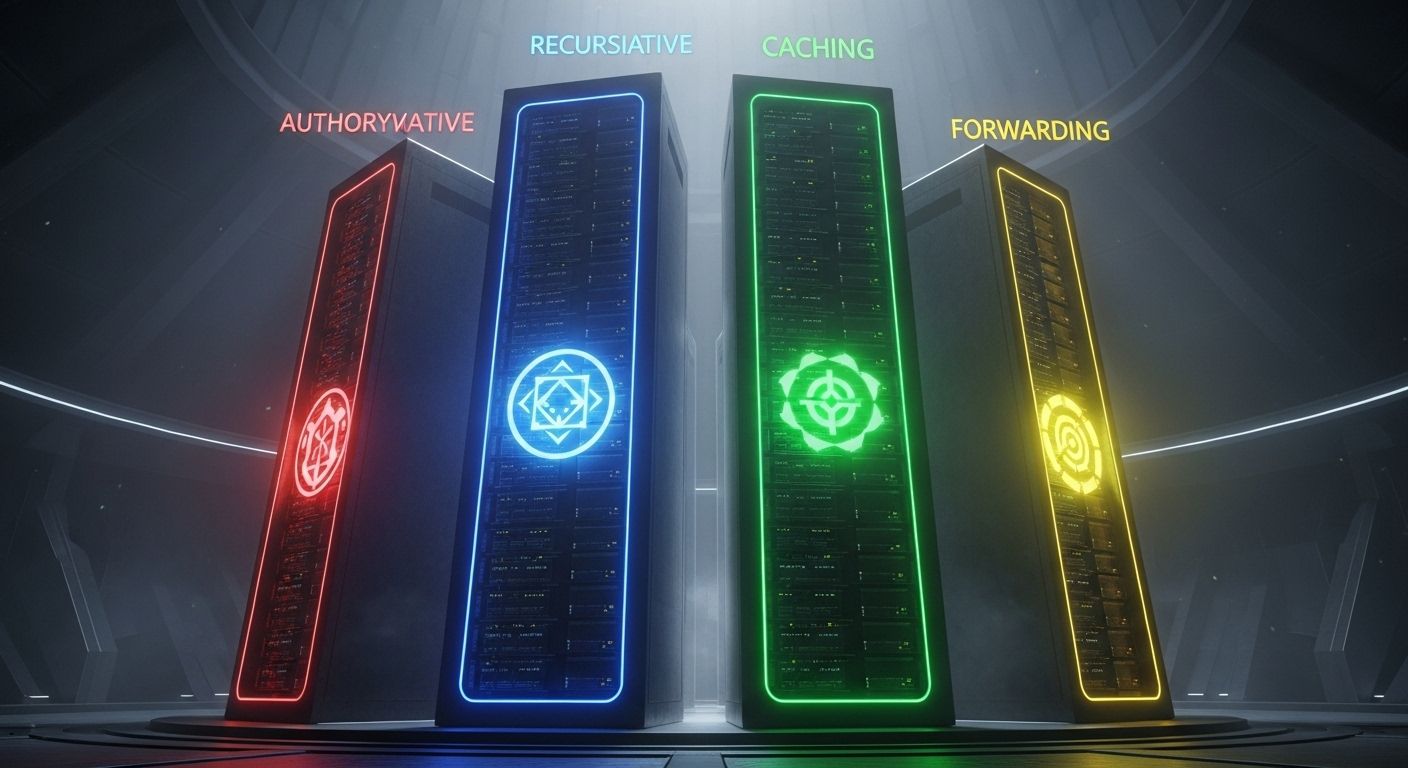
Not all types of domain name server wear fancy titles. Enter the *forwarding* and *caching* resolvers—often the unsung workhorses in corporate networks or your home router. A forwarding resolver? It’s like your cousin who *says* he’ll handle the wedding RSVPs… but really just forwards everything to Mom. It passes queries upstream (to Google’s 8.8.8.8, Cloudflare’s 1.1.1.1, or your ISP) instead of diggin’ through roots and TLDs itself.
Caching? Oh, that’s gold. Every time a resolver gets an answer, it tucks it away for a spell—defined by the record’s TTL (Time to Live). So the next time someone asks, *“Where’s peternakdigital.com?”*—boom. Served from cache. Faster than a greased pig at the county fair. Fun stat: recursive resolvers can slash query times by up to 87% thanks to caching (per APNIC, 2023). Now *that’s* efficiency.
Secondary (Slave) Name Servers: Redundancy, Y’all
Ever had your site go *poof* ’cause the one server holding your DNS took a dirt nap? Yeah—ain’t no fun. That’s why authoritative zones usually have *secondaries*—servers that *copy* the zone file from the *primary* (master) server via zone transfers (AXFR/IXFR). They don’t take edits directly—you update the primary, and the secondaries sync up like backup singers harmonizin’ off one mic.
Redundancy ain’t just nice—it’s non-negotiable. ICANN *requires* at least two name servers for .com registration. Most folks run three or four—scattered across data centers, zones, even continents. ‘Cause when the grid blinks in Dallas, you still wanna be online in Dublin. Solid uptime? That’s just good manners—and smart use of the types of domain name server.
Stub Resolvers: The Lightweight Sidekick
Your laptop, phone, or smart fridge? They ain’t runnin’ full recursive DNS. Nah—they’ve got a *stub resolver*: a barebones client that just knows *one* thing—*“Where’s my resolver?”* (usually your router or ISP’s server). It sends the query, waits, and hands the answer to the browser. No caching. No recursion. Just… relaying. Like a town crier who only shouts what the mayor whispers in his ear.
It’s elegant in its simplicity. And it keeps your IoT toaster from tryin’ to resolve weather.com by interrogating root servers. (Spoiler: that’d go *real* bad.) Stub resolvers keep the heavy lifting where it belongs—making the full types of domain name server ecosystem scalable, not chaotic.
Private vs. Public DNS: Behind the Firewall & Out on the Range
Now let’s talk *where* these types of domain name server live. *Public DNS*—like Google’s 8.8.8.8 or Cloudflare’s 1.1.1.1—is out in the wild, free for anyone, optimized for speed and security (hello, DNS-over-HTTPS). But *private DNS*? That’s your company’s internal phonebook—resolving intranet.peternakdigital.local or db01.corp without leakin’ secrets to the outside world.
You can even run split-horizon DNS: same domain, *different* answers inside vs. outside the network. Ask for mail.peternakdigital.com from HQ? Get the internal IP. From your phone at Waffle House? Get the public one. Sneaky. Smart. Essential for enterprises—and a slick trick in the types of domain name server playbook.
Putting It All Together—And Where to Dig Deeper
So yeah—the types of domain name server ain’t just a list. It’s a choreographed dance: stub resolver → recursive resolver → root → TLD → authoritative. Each handoff tighter than a snare drum at a bluegrass jam. Mess up one step? The whole song skips.
Want to geek out more? We’ve got your back:
→ Get the full lay of the land over at Peternak Digital
→ Browse our ever-growin’ toolkit in Tools
→ Ready to bend DNS to your will? Dive into Reverse Look-Up Zone Configuration—where PTR records and subnet sorcery collide.
Frequently Asked Questions
What type of DNS is SOA?
SOA isn’t a types of domain name server—it’s the *Start of Authority* record, the very first entry in any DNS zone file. It defines the primary name server, admin contact, serial number, and refresh intervals. Think of it as the deed to the domain’s DNS real estate—quiet, essential, and non-negotiable for the types of domain name server hierarchy to function smoothly.
What are the different types of domain name systems?
When folks ask about “types of domain name systems,” they usually mean the types of domain name server roles: *recursive resolvers*, *root servers*, *TLD servers*, *authoritative name servers* (primary/secondary), *forwarding servers*, *caching servers*, and *stub resolvers*. Each plays a distinct part in translating domains to IPs—like instruments in a well-tuned DNS orchestra.
What are the 3 levels of DNS?
The DNS resolution process flows through three logical tiers: (1) the **root servers** (the top of the tree), (2) the **TLD servers** (handling .com, .org, etc.), and (3) the **authoritative name servers** (holding the final records for a domain). Though technically, you’ve also got the client-side *stub resolver* and the *recursive resolver* doing the legwork—so it’s more like 3 *core* levels, with support cast around 'em in the full types of domain name server lineup.
What are 13 name servers?
The “13 name servers” refers to the 13 logical *root server identifiers* (A.root-servers.net through M.root-servers.net). But here’s the kicker—they’re not *just* 13 machines. Thanks to *anycast*, each identifier is served by *hundreds* of physical instances worldwide for resilience and speed. So while we say “13,” the real number’s closer to 1,400+ nodes (per root-servers.org, 2024). That scalability? Pure poetry in the types of domain name server symphony.
References
- https://www.iana.org/domains/root/servers
- https://root-servers.org
- https://www.rfc-editor.org/rfc/rfc1034
- https://www.apnic.net/2023/08/dns-caching-efficiency-study