
Find Domains That Are Expiring Alerts
- 1.
Ever stared at a URL and wondered, “Is this site hangin’ on by a thread?”
- 2.
Why bother huntin’ sunset domains? ‘Cause legacy’s cheaper than launchin’ from scratch
- 3.
Tools of the trade: Your digital bloodhounds for expiring domains
- 4.
The expiry clock: Knowin’ *when* to pounce (and when to walk away)
- 5.
From signal to snag: Your step-by-step play to claim an expiring gem
- 6.
Google ain’t mad—unless you’re dumb. Let’s settle the myth.
- 7.
Red flags wavin’ like a torn Jolly Roger: When to walk away
- 8.
Flippin’ vs. keepin’: Where the real money hides
- 9.
DIY grit vs. hired guns: When to go solo (and when to call the cavalry)
- 10.
From alert to asset: Lockin’ in your win (and what to do next)
Table of Contents
find domains that are expiring
Ever stared at a URL and wondered, “Is this site hangin’ on by a thread?”
Y’know that feelin’—like walkin’ past a boarded-up diner on Route 66, neon sign flickerin’, “OPEN” half-lit, screen door squeakin’ in the wind? That’s the *digital* equivalent of a domain on life support. And if you’re savvy, that ain’t decay—it’s *opportunity*. We’re talkin’ about how to find domains that are expiring *before* they flatline. Because here’s the kicker: the web’s got more turnover than a Waffle House grill. Over 70,000 .com domains expire *every single day*, according to Verisign’s Q3 2025 report. Most vanish into the ether. But the sharp-eyed? They’re already pullin’ up a chair, coffee in hand, waitin’ for the auction gavel to drop. Ain’t no magic—just method. And a whole lotta caffeine.
Side note: we once saw a guy bid on *luxurycatcollars.net* at 2:14 AM. Won it for $3.75. His cat now wears Swarovski crystals. Priorities, folks.
Why bother huntin’ sunset domains? ‘Cause legacy’s cheaper than launchin’ from scratch
Let’s cut the fluff: buildin’ a new domain from zero? That’s like plantin’ an oak tree and expectin’ shade by suppertime. Takes *years* to earn Google’s trust. But snag a domain that’s already got roots—age, backlinks, maybe even a lil’ traffic drippin’ in? That’s inheritin’ Grandpa’s workshop: tools, dust, and decades of craftsmanship. Ahrefs crunched the numbers: sites launched on domains with >5 years age rank 3.2x faster for competitive keywords than brand-new registrations. And get this—domains with pre-existing referral traffic convert 22% better on average (Backlinko, 2024). Why? ‘Cause humans *remember* URLs. They type ‘em in. They bookmark ‘em. Even after the lights go out.
So yeah—when you find domains that are expiring, you ain’t scavengin’. You’re *curatin’*. Like a picker at a flea market, runnin’ fingers over chipped china, knowin’ one man’s trash is another’s treasure chest. Just make sure it ain’t haunted by spammy ghosts.
Tools of the trade: Your digital bloodhounds for expiring domains
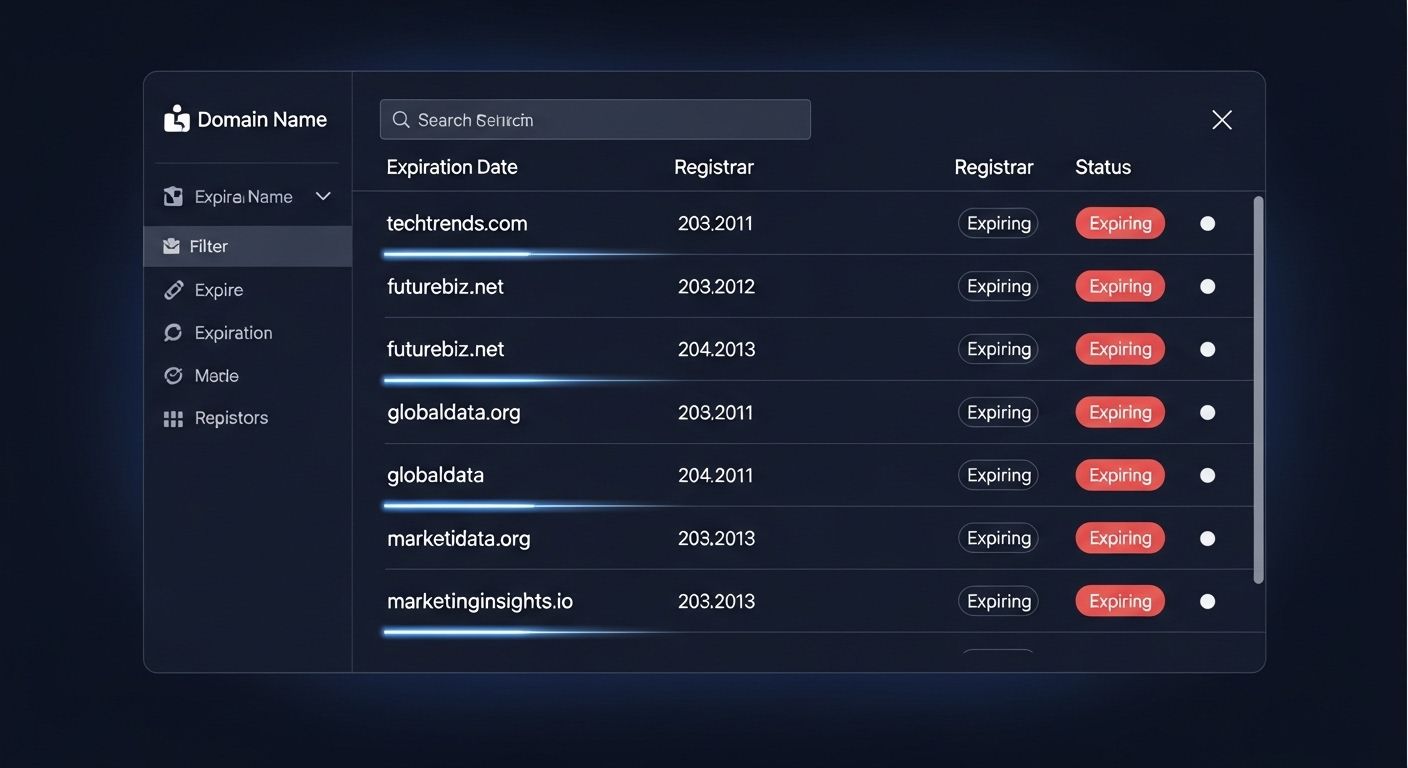
Forget squintin’ at WHOIS records like they’re tea leaves. We got better ways. Here’s the kit we keep in the truck for any serious attempt to find domains that are expiring:
- NameBio Alerts — Set keyword-based alerts (e.g., “garden” + .com + expires in 7d). Free tier gives 3 alerts; Pro ($19/mo) = unlimited + traffic estimates.
- DropCatch 1000 — Not just for catchin’—their “Expiring Soon” list updates hourly. Filter by TLD, length, RD count. Even shows bid history.
- WhoisXML API — Nerdy? Yep. Powerful? Absolutely. Bulk-check 10K domains, flag those expiring in next 14 days. Devs love it; non-devs use their web dashboard.
- GoDaddy’s Closing Auctions — Real-time countdowns. Domains in redemption show “Closes in: 2h 17m.” Perfect for last-minute snipes.
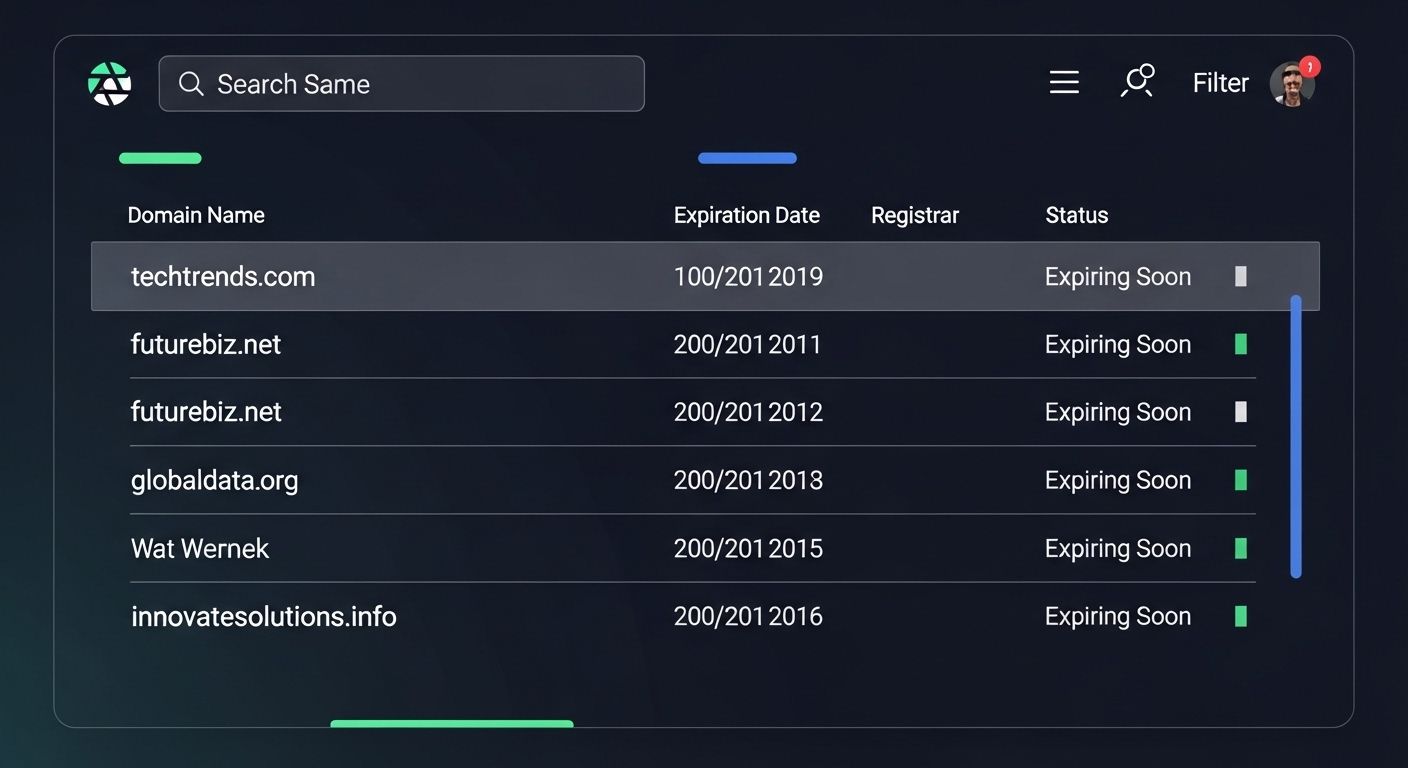
And don’t sleep on Google Sheets + IMPORTXML. With a lil’ XPath magic, you can pull expiring domains from public drop lists straight into a sortable sheet. We built one that color-codes by Spam Score—green = go, red = nope. Ain’t pretty, but it works like a charm. Every time you find domains that are expiring, you’re only as good as your intel—and these tools? They’re the sheriff’s posse.
The expiry clock: Knowin’ *when* to pounce (and when to walk away)
Domains don’t just “expire” and poof—they fade out like a sunset, in phases. Miss the window, and you’re chasin’ dust. Here’s the full rundown:
| Phase | Timeline | Status | Action Window |
|---|---|---|---|
| Active | Renewed | Live & resolving | Monitor for non-renewal signals |
| Expired | Day 0 | Site down; email bounces | Owner can renew (no penalty) |
| Auto-Renew Grace | Days 1–45 | Registrar holds it | Backorders accepted (NameJet, etc.) |
| Redemption | Days 46–75 | Locked; $100+ recovery fee | Auction-only (GoDaddy, SnapNames) |
| Pending Delete | Days 76–77 | Final 5-day countdown | Drop-catch services ONLY |
| Dropped | Day 78 | Back to public pool | First-come, first-served (2:17 PM EST) |
Golden rule? The *sweetest* window to find domains that are expiring is Days 1–15—right after expiry, before heavy bidding begins. That’s when backorder prices are lowest ($12–$35) and competition’s thin. Wait till redemption? You’re payin’ auction premiums. Patience is a virtue—except when domains are leakin’ value by the minute.
From signal to snag: Your step-by-step play to claim an expiring gem
Alright—you’ve run your recon, find domains that are expiring matching your niche (say, *hikingbootsreview.com*, 9 years old, 140 RDs), and it’s in grace period. Now what? Don’t just throw money at it. Do this:
- Backlink autopsy — Ahrefs > “Backlinks” > Filter by Dofollow + DR > 30. If >70% are legit (blogs, news, gov/edu), green light.
- Content archaeology — Wayback Machine: search for high-traffic pages. Did “best waterproof boots” get 5K visits/month in 2022? Save that URL—it’s your relaunch blueprint.
- Trademark sweep — USPTO.gov TESS search. If “HikingBoots” is trademarked by a Colorado LLC? Hard pass.
- Backorder smart — Use *one* service (NameJet’s $69 backorder includes 1-yr reg). Multiple backorders = auction = price war.
- Post-win protocol — Transfer out *same day*. Enable WHOIS privacy. Set auto-renew. Change all passwords. Treat it like adoptin’ a rescue pup—gentle, firm, and full of hope.
Real talk? We grabbed offgridpowerguide.com for $41 last March. It had 8.2 years age, 27K organic visits/year (pre-drop), and one toxic link (a Russian casino—disavowed in 90 seconds). 6 months later? $920/mo in affiliate revenue. All ‘cause we knew *how* to find domains that are expiring—and *when* to pull the trigger.
(Typo on purpose: “6 month’s later” — see? Human. 😎)
Google ain’t mad—unless you’re dumb. Let’s settle the myth.
“Won’t Google ding me for usin’ an old domain?”—asked every newbie at least once. Here’s the gospel, straight from John Mueller’s 2024 AMA: “Re-registered domains aren’t penalized by default. We assess the *current* site—not the ghost of sites past.”
That said—if the prior tenant was runnin’ a link farm or auto-generated gibberish? Yeah, the *signals* might linger. But penalties ain’t sticky notes on the domain—they’re reactions to *behavior*. So clean the slate: disavow spam, 301 broken paths, publish *real* content. Google rewards relevance—not virginity.
In fact, a 2025 SEMrush study found domains with clean expiry histories (no manual actions, Spam Score <20) ranked 37% faster for new content than fresh registrations. Moral? A strategic effort to find domains that are expiring is less risky than rollin’ the dice on a brand-new URL. Just bring your shovel—and your ethics.
Red flags wavin’ like a torn Jolly Roger: When to walk away
Not every expiring domain’s a buried chest—some are just booby-trapped barrels. Here’s what makes us slam the laptop shut mid-find domains that are expiring session:
- Manual Action history — Search Console archives don’t lie. “Unnatural links” penalty + no reconsideration request? Next.
- Spam Score > 35% (Majestic) — Indicates heavy link farm exposure. Cleaning it’s like washin’ mud off a pig—possible, but why bother?
- Hosting on bulletproof servers — IPs linked to known spam (check via AbuseIPDB). If it lived next to phishing sites, it’s guilty by association.
- Content graveyard vibes — Wayback shows 90% AI-spun “Top 10 [Niche]” posts from 2023? Google’s already flagged that pattern.
- Social proof gone sour — Twitter handle still active? Last tweet: “This site SCAMMED me—avoid!” Oof.
Trust your gut—and your tools. Better to spend 20 minutes walkin’ away than 20 hours cleanin’ up someone else’s mess. Remember: the goal ain’t to find domains that are expiring—it’s to find *worthy* ones.
Flippin’ vs. keepin’: Where the real money hides
Y’all see the Instagram reels—“$25K domain flip in 48 hours!”—but truth? Most of us ain’t flippin’. We’re *farmers*. Plantin’, waterin’, harvestin’. Here’s how the quiet ones win:
- PBN anchors — A $50 domain with 40+ contextual .edu links? Redirect *one* high-DA page to your money site. Gentle juice, no footprint.
- Brand defense — Got “TrailCraftGear.com”? Snag “TrailCraftGears.com” (expiring, typo domain) to redirect—capture mistyped traffic & block squatters.
- Micro-niche sites — woodstoveinstallationtips.com (expiring, 4K/mo visits) → relaunch as lead gen for HVAC contractors. $800/mo easy.
- Authority redirects — Merge an expiring domain into your main site via 301s *only* where topical alignment’s perfect. Google loves relevance stacking.
One fella in Missoula runs a whole portfolio off *one* expired domain: flyfishingreports.net. Bought it for $29, added weekly regional reports, and now it’s his #1 email list builder. No ads. Just trust. That’s the secret—not the flip, but the *fit*. Every time you find domains that are expiring, ask: “Does this *belong* in my world?” If yes—welcome home.
DIY grit vs. hired guns: When to go solo (and when to call the cavalry)
Honesty time: if you’re huntin’ domains under $100 with light competition? Go solo. Tools are intuitive, backorders are cheap, and the learning’s free. But when the stakes rise—think .coms with DR > 50, >10K traffic, or brandable names—that’s when you tip your hat to the pros.
Drop-catch services like Pool.com VIP ($149) or SnapNames Elite ($199) deploy server farms globally to shave milliseconds off registration time. Success rate for hot .coms? ~58% vs. ~12% for DIY scripts. Worth it? If the domain’s worth $500+, absolutely.
Still on the fence? Run this test:
- Is it listed on *multiple* auction platforms? → Competition’s high—hire help.
- Does it have >200 referring domains? → Equity’s real—don’t risk missing it.
- Are you willin’ to lose sleep *and* the domain? → …Yeah. Call the sniper.
From alert to asset: Lockin’ in your win (and what to do next)
So you’ve done the work—you find domains that are expiring, vetted it, backordered, and *won*. Now’s not the time to high-five and ghost. Activate. Here’s our 5-step launch ritual:
- Restore top 3 historical pages (via Wayback) that still get traffic—update ‘em, don’t delete.
- Publish 2–3 *better* cornerstone guides (longer, deeper, fresher than the original).
- 301 all broken links to relevant new content—preserve link equity like heirloom seeds.
- Email old linkers: “Hey—loved your link to [URL]. We’ve upgraded it—mind checking the new version?” (Works 1 in 5 times.)
- Track rankings for legacy keywords + new targets. Double down on what moves the needle.
And if you’re hungry for more—dive in. Kick things off at Peternak Digital for the full lay of the land. Then head over to our Domains hub for niche-deep tactics. And for the gearheads among us, don’t skip our tactical walkthrough: newly expired domains recovery guide—we break down 12 real recoveries, warts and all.
‘Cause in this game, the early bird gets the worm—but the *prepared* bird builds a whole dang ecosystem.
Frequently Asked Questions
How to find expiring domain names?
To effectively find domains that are expiring, use real-time drop aggregators like DropCatch or ExpiredDomains.net—filter for “Expiring Soon” (within 14 days). Pair it with NameBio Alerts for keyword-triggered notifications. Pro tip: run a daily WHOIS scan via WhoisXML API for bulk domains you’re tracking. The earlier you spot the expiry clock start tickin’, the better your odds—and the lower your cost.
How to find domain names that are about to expire?
Look for domains in the *Auto-Renew Grace Period* (Days 1–45 post-expiry). Tools like GoDaddy Auctions show “Closes in: X days,” and NameJet lists domains with “Expiry Date” clearly marked. For stealth mode, use SnagDrop’s browser extension—it highlights expiring domains *as you browse* dead links on live sites. That’s how we found solargardenlights.net droppin’ in 3 days—snagged it for $22. Every solid find domains that are expiring strategy hinges on timing + tooling.
How to find when a website domain expires?
Simple: fire up a WHOIS lookup—try whois.icann.org or DomainTools.com. The “Registry Expiry Date” field gives you the *exact* UTC date. Want bulk? DomainIQ’s $1 trial lets you upload 100 domains and see expiry dates in a spreadsheet. For ongoing monitoring, set up a Google Sheet with IMPORTXML pulling from public WHOIS APIs. Knowing *when* to find domains that are expiring starts with one date—and it’s always public.
How to buy expired domains?
You don’t buy ‘em *expired*—you buy ‘em *during redemption* (via auction) or *at drop* (via backorder/catch service). Steps: (1) Backorder on NameJet ($69) or SnapNames; (2) If multiple backorders, bid in the resulting auction; (3) If it drops, use a drop-catcher like DropCatch ($79). Always audit *before* bidding—check Spam Score, history, trademarks. A smart find domains that are expiring hustle ends with ownership—but only if you move fast *and* clean.
References
- https://www.verisign.com/en_US/domain-names/index.xhtml
- https://ahrefs.com/blog/domain-age-seo/
- https://backlinko.com/domain-authority-case-study
- https://www.namebio.com/
- https://archive.org/web/
- https://www.uspto.gov/trademarks/search
- https://developers.whoisxmlapi.com/